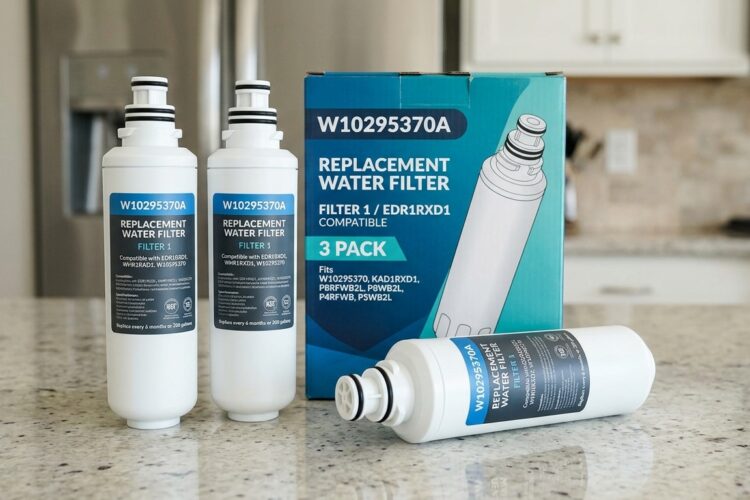
Anyone who has searched for a refrigerator filter knows how quickly the process turns into a code-breaking exercise. One product page lists ten or more identifiers, some starting with W, some with P, some with letters that look like they belong to a different brand altogether. The natural question is whether they all describe the same cartridge, or whether picking the wrong one means a wasted afternoon.
This guide approaches the topic as a decoder. It explains why so many codes appear on a single listing, what a white three-pack setup means in day-to-day terms, how this style of filter works, and which checks are worth doing before you order. It is general information only. It is not a review, and it does not describe hands-on use of any specific product.
Introduction: Why One Filter Carries So Many Names
Appliance filters often outlive the naming systems created for them. Over the years, the same physical cartridge design can be sold under the refrigerator maker’s brand, under sister brands, under retailer labels, and under older part numbers that were later replaced. Third-party manufacturers then list every code they can reasonably link to their fit, so that shoppers searching for any one of those codes will find the product.
The title here follows that pattern. It lists W10295370A, W10295370, EDR1RXD1, WHR1RXD1, KAD1RXD1, P8RFWB2L, P8WB2L, P4RFWB, P5WB2L and the phrase “Filter 1.” Those identifiers appear to span several brands that share a common filter housing, including Whirlpool and related names. The word “compatible” in the title is the key to reading it correctly: it describes intended fit, and it does not mean the cartridge comes from the original manufacturer.
The remainder of the title tells you the color of the cartridge body (white) and the quantity (three). Those details are easy to skip but matter for planning, so this article covers them as well.
How a Refrigerator Water Filter Works
Carbon as the Core Material
Cartridges in this class generally use activated carbon, often compressed into a block. Carbon has a vast network of microscopic pores, so even a small piece offers a huge surface area. As water flows through, certain compounds attach to that surface, a process called adsorption. This is why carbon is commonly associated with reducing chlorine taste and odor.
Mechanical Trapping
The dense structure of a carbon block can also catch fine particles. How much it catches depends on the pore size and design of each manufacturer’s product.
The Reality of Limited Capacity
Carbon fills up. Once its adsorption sites are occupied, performance falls off, and a block loaded with sediment can restrict water flow. This is the reasoning behind the standard six-month change interval recommended by many manufacturers.
Boundaries Worth Remembering
A cartridge like this does not soften water, prevent scale, or make microbiologically unsafe water safe. Its claims apply only to the substances covered by its own testing. Households with private wells, recent advisories or specific contamination concerns should consult their water utility’s report or an accredited laboratory rather than relying on a refrigerator filter alone.
Reading the Long Code List
Here is a plain-language way to approach the identifiers in this title.
The W-series numbers (W10295370A and W10295370) are part numbers tied to this filter fit. The “A” suffix typically marks a revision, and listings often group both versions together.
The EDR, WHR and KAD codes are brand-linked identifiers. EDR1RXD1 relates to the Everydrop name, WHR1RXD1 to Whirlpool, and KAD1RXD1 to KitchenAid.
The P-series codes (P8RFWB2L, P8WB2L, P4RFWB, P5WB2L) are older style designations that appeared on earlier packaging and are still used in parts cross-references.
“Filter 1” is the size-and-style name that many of these brands use in their manuals.
A useful rule is that matching codes on a listing are a starting point, not a guarantee. The reliable approach is to find the filter number in your refrigerator’s owner’s manual or on the cartridge currently installed, then check that it appears in the compatibility information.
Key Features of This Type of Replacement Filter
Shared-Housing Compatibility
The principal feature is fit. This cartridge style uses a push-in, quarter-turn mechanism that locks into a housing found across many refrigerators under related brands. When the match is right, no adapter or tool is needed.
Carbon-Based Media
Expect an activated carbon core. Terms such as “carbon block” describe the material, but they are not themselves evidence of performance.
Certification Information
Independent standards commonly cited for refrigerator filters include:
- NSF/ANSI 42, relating to taste, odor and particulates
- NSF/ANSI 53, relating to specific health-related substances listed on each certificate
- NSF/ANSI 401, relating to certain incidental compounds
A certificate belongs to a particular product from a particular manufacturer. If the listing names a standard, look for the testing organization and supporting documents. General wording such as “reduces impurities” offers little to verify.
The White Color Option
Mentioning white in the title usually refers to the cartridge body or cap. It is a cosmetic detail and does not by itself indicate any difference in filtration. Some people simply prefer a cartridge that blends in with a light-colored housing or grille.
The 3-Pack Format
Three cartridges at a typical six-month interval cover roughly eighteen months. That reduces reorder frequency, though it also means storing spares. Keep them sealed in their packaging in a cool, dry place away from sunlight and strong odors.
Tool-Free Replacement
The swap usually takes a few minutes. Turn and release the old cartridge, insert the new one, turn it until it locks, and flush according to the instructions.
Practical Ways to Use It
Drinking Water
Chilled dispenser water is the obvious use, particularly for people who notice a disinfectant taste in tap water.
Ice
Ice absorbs odors readily, so cleaner supply water can help. A clean ice bin and covered freezer foods matter too.
Hot Drinks and Cooking
Coffee, tea, rice, pasta and soups all start with water, and some people prefer filtered water for these tasks.
Pets and Plants
Dispenser water is a convenient source for pet bowls and watering cans.
Refilling Bottles
The dispenser can work as a refill station for reusable bottles.
For infant formula, follow pediatric and formula-manufacturer guidance, which may call for specific water preparation.
Habits That Support Good Results
- Flush several gallons after installation to clear air and carbon fines.
- Write the install date on the cartridge.
- Check for leaks right after installing and again the next day.
- Reset the indicator light using your manual’s instructions.
- Store spare cartridges sealed and away from heat.
Who It May Be Suitable For
- Owners of refrigerators under Whirlpool-related brands whose manuals call for this filter style
- Households comparing original and third-party cartridges
- People who prefer keeping spares on hand rather than reordering every cycle
- Anyone who wants better-tasting dispenser water without plumbing changes
It may be a poor match for refrigerators using a different filter type, or for situations where water concerns go beyond carbon filtration.
Important Things to Consider Before Ordering
- Verify the filter number using your manual, model label or current cartridge.
- Understand “compatible.” It signals intended fit, not original manufacture.
- Look for traceable certification instead of vague claims.
- Check the warranty language in your refrigerator’s documentation regarding third-party parts.
- Don’t force a poor fit. If it will not seat smoothly, stop and recheck.
- Know your water. Refrigerator filters are meant for water already considered safe to drink.
- Read return terms, since fit is the main risk.
- Plan disposal. Some manufacturers offer recycling programs.
- Match the interval to your usage. Heavy use or sediment may require earlier changes.
Comparing General Filtration Categories
- Refrigerator cartridges: convenient and connected to the dispenser and ice maker, but limited to compatible models.
- Pitcher filters: portable and install-free, with smaller capacity.
- Faucet-mounted filters: treat water at the sink, with fit and flow varying by faucet.
- Under-sink systems: larger capacity, sometimes multi-stage, with installation required.
- Whole-house systems: treat every outlet but involve complex setup.
- Reverse osmosis: addresses a broad range of dissolved substances, with space, installation and wastewater trade-offs.
Many households combine more than one approach.
Frequently Asked Questions
Are all these codes really the same filter?
They are grouped because they share a common fit. Small differences can exist, so confirm with your own documentation.
Why do KitchenAid and Whirlpool codes appear together?
Related brands often share filter housings, so listings reference all of them.
What does the “A” in W10295370A mean?
It usually indicates a revised version of the part number.
Does the white color change how it filters?
Color is generally cosmetic.
How often should I replace it?
About every six months is a common recommendation, or sooner if flow drops.
Is cloudy water normal at first?
Often. Flushing several gallons usually clears it.
Do I need tools or a plumber?
Typically not. Follow your manual.
Can I use no filter?
Many models accept a bypass plug. Check your manual.
Does it remove everything?
No. It addresses only what its design and certification cover.
How do I store the extras?
Sealed, cool, dry, and away from strong odors.
Conclusion
The long code string in this listing looks intimidating, but it describes one idea: a replacement cartridge aimed at a widely shared refrigerator filter fit. Once you know how to read the codes, the process gets simpler. Confirm the filter number for your refrigerator, look for real certification details, store the spares properly, and keep a replacement schedule.
Treat the cartridge as a taste-and-odor improvement within clear limits, and consult your local water report if you have broader concerns.