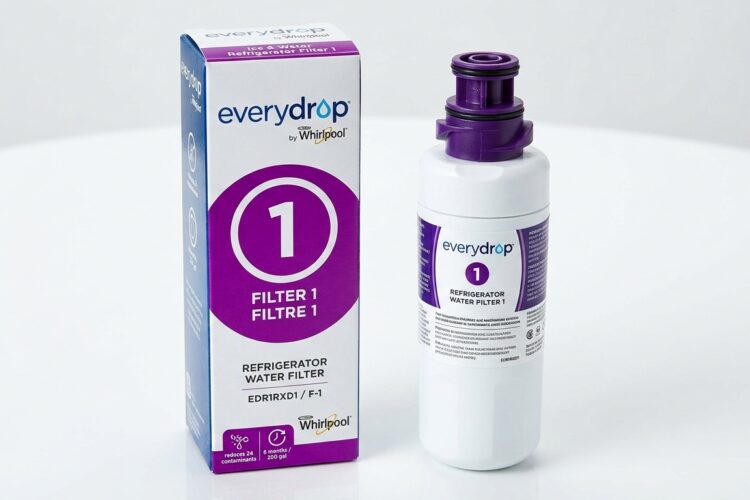
The water dispenser on a refrigerator door is one of those features that gets used every single day and thought about almost never. You press a lever, fill a glass, maybe grab a few ice cubes, and move on. What happens between the water line and your cup is easy to overlook, but it is worth understanding, especially if you have ever noticed an odd taste or smell in your drinking water or ice. For households with a Whirlpool, Maytag, Amana, KitchenAid, or JennAir refrigerator, the everydrop brand is likely already part of that picture. This article looks closely at one of its more common models: the everydrop by Whirlpool Ice & Water Refrigerator Filter 1, purple, model EDR1RXD1.
The goal here is not to tell you what to do. It is to lay out what this filter is, what it does, who it tends to suit, and what to keep in mind before and after installing one. If you are researching a replacement filter or simply curious about the purple cylinder behind the dispenser, the sections below should give you a clear and balanced picture.
What This Filter Actually Is
The EDR1RXD1 is a cylindrical refrigerator water filter, roughly seven inches tall and under two inches in diameter, finished in purple. It installs with a push-and-twist motion: line it up, push it in, turn clockwise until it locks. On most compatible refrigerators this takes well under a minute and requires no tools, no technician, and no disassembly of anything.
The purple color is not decorative. everydrop uses color and number coding to distinguish filter models, and Filter 1 is purple, corresponding to the EDR1RXD1 part number. If you have been using the older W10295370A, this filter is its direct replacement. The coding system exists for a simple reason: to reduce the chance of grabbing the wrong filter off a shelf.
Compatibility is broad but not universal. The filter fits a wide range of refrigerators across Whirlpool’s brand family, including Maytag, Amana, KitchenAid, and JennAir, plus some Kenmore models. It appears in French door, side-by-side, and top-freezer configurations. That said, brand alone is never enough to confirm a match. The reliable method is to check your refrigerator’s manual or read the part number printed on the old filter. When in doubt, searching your specific refrigerator model number is the safest route.
What It Does Inside the Refrigerator
A refrigerator filter has one job: reduce certain contaminants and improve the taste and smell of the water and ice that pass through it. The EDR1RXD1’s specifications are worth examining in some detail, because this is where the differences between filters become meaningful.
The filter carries NSF International certification under three standards: NSF/ANSI 42, 53, and 401. In plain terms, Standard 42 covers aesthetic issues such as taste, odor, and chlorine reduction. Standard 53 addresses health-related contaminants, including lead, mercury, and cysts. Standard 401 covers emerging contaminants of concern, such as residues from pharmaceuticals and personal care products. Many generic filters meet only one of these standards. This one meets all three, which means its performance has been independently verified across a broader range of claims.
The manufacturer states that the filter reduces 70 potentially harmful contaminants. That figure comes from the combined certification testing and includes categories such as heavy metals, volatile organic compounds, pesticides, and medication residues. Another point worth noting is microplastics. everydrop claims the filter reduces 99% of microplastics, including particles many times smaller than a grain of sand. Microplastics are a relatively recent topic in filtration, and certification standards in this area are still evolving. For households that care about this issue, the claim is at least a documented one rather than a vague marketing line.
Inside, the filter uses coconut-shell activated carbon. The company describes a three-stage filtration design: an outer layer catches larger particles, a middle layer handles medium-sized ones, and the carbon core adsorbs contaminants at a microscopic level. Coconut-shell carbon is not a unique technology, but its porous structure is well suited to adsorbing organic compounds and residual chlorine. The renewable source of the material is a reasonable secondary benefit.
One more detail that is easy to miss: the filter is rated for six months of use or approximately 200 gallons (757 liters), whichever comes first. That cycle aligns with general industry practice. Households with heavy water use, or with water that carries more sediment, may find the filter reaches the end of its useful life sooner. Many refrigerators have a replacement indicator light, but those lights typically estimate based on time or flow rather than measuring the filter’s actual condition.
How It Fits Into Daily Life
The filter does not create water or change its temperature. It simply makes the water passing through it cleaner in specific, measurable ways. Its real-world uses are therefore the uses of your dispenser and ice maker.
Drinking water is the most obvious one. If your tap water has a noticeable chlorine taste, or if you are concerned about pipe sediment and similar issues, the filter acts as a final barrier at the point of use. Many users report that after installing a fresh filter, the chlorine note in the water becomes noticeably fainter and the taste feels more neutral. That experience is subjective and depends on local water quality, but it is precisely the problem the filter is designed to address.
Ice is an underrated use case. Ice cubes carry the taste of the water they were made from, and many people only notice the faint chemical or stale note in their ice after changing a filter. A clean filter tends to produce clearer, more neutral-tasting ice, which matters for households that go through ice regularly.
Cooking and hot drinks are another angle. Using filtered water for soup, tea, or coffee can reduce the interference of water impurities with flavor. Whether the difference is dramatic depends on your palate and your water supply, so it is best to treat this as a modest benefit rather than a transformation.
Installation is genuinely straightforward. On most refrigerators the filter sits in the upper right corner of the fresh food compartment or behind the base grille. Turn off the dispenser if there is a switch, twist the old filter counterclockwise to remove it, take the new one out of its packaging, peel off the protective cap, align it with the arrows, push it in, and turn clockwise until it locks. After installation, run two to three gallons of water through the dispenser to flush out trapped air and loose carbon dust. This step is frequently skipped, and skipping it is the usual reason people complain about black particles or strange tastes right after a change. A couple of minutes of flushing resolves it.
Who This Filter Tends to Suit
One group is what you might call the original-equipment crowd. Their reasoning is simple: the refrigerator is from the Whirlpool family, the filter is made by the same company, and the fit and compatibility come with official backing. For people who would rather not spend time researching third-party alternatives and their varying reputations, this is a sensible way to keep things simple. The EDR1RXD1 generally earns solid marks for fit and sealing, and complaints about leaks or filters that will not seat properly are relatively uncommon compared with the generic category.
Another group is households with specific water-quality concerns. If there are young children or pregnant individuals at home, or if someone is particularly worried about lead or cysts in drinking water, the three NSF certifications and the specific contaminant list provide a traceable form of reassurance. A filter is not a guarantee of perfect water, but independent testing means the claims are not resting solely on the manufacturer’s word.
A third consideration is warranty coverage. Some manufacturers’ warranty terms may restrict coverage for damage caused by non-original filters. This will not affect everyone, but for anyone who prefers not to take on even a small avoidable risk, an original filter is the more cautious choice.
Conversely, if price is the dominant factor, or the refrigerator is older and water quality expectations are modest, cheaper compatible options do exist. That is a trade-off each household makes for itself, and there is no single right answer.
Things Worth Considering Before You Commit
Price is the unavoidable topic. On Amazon, a single EDR1RXD1 typically sits around the fifty-dollar mark. Within the filter category, that is not cheap. Many compatible filters cost half as much or less. What the premium buys is original-equipment fit, three NSF certifications, and the brand’s quality control system. Whether that is worth it depends on how much you value those factors. Some users report trying cheaper options and eventually returning to the original; others find the premium hard to justify and look for alternatives. Both positions are defensible.
A small installation detail deserves emphasis. The process is simple, but arrow alignment matters. The arrows on the filter and the housing need to point the same way, and the filter must be turned fully to lock. A filter that is not seated correctly can cause slow flow, increased noise, or even seepage. Some users have reported the filter door failing to close because the filter was not properly aligned. After installation, dispense a glass or two and watch for leaks before walking away.
The initial flushing step should not be skipped. Loose carbon dust and air in the lines are normal, and running two to three gallons through the dispenser clears them. It takes a minute or two, but the difference in the first glass of water is significant.
Treat the six-month interval as guidance, not law. Households with high water use, or with harder or more sediment-heavy water, will exhaust the filter faster. Slower dispensing, a returning taste or odor, or the refrigerator’s indicator light are all reasonable signals. On the other hand, a filter that sits in a damp environment for too long is not ideal either, so very long overruns are not advisable even in low-use households.
Finally, be realistic about what a refrigerator filter can and cannot do. It targets taste, odor, and specific contaminants. It does not soften water, does not remove calcium and magnesium, and does not address every possible dissolved solid. If your water supply has serious underlying problems, such as very high hardness or unusual industrial contamination, a fridge filter is a last line of defense, not a substitute for whole-house treatment or a targeted water solution. Expectations should be built on that understanding.
A Brief Look at Filter Categories
Refrigerator filters generally fall into a few camps, each with its own logic.
Original certified filters, like the everydrop EDR1RXD1, are matched to the refrigerator by design. Sealing structures and connector dimensions do not need to be guessed at. Certification coverage tends to be more complete, and three NSF standards in one product is more common in this camp. The downsides are the higher price and the low cross-compatibility: change refrigerators and you may need a different filter model entirely.
Generic compatible filters are the other major category. These are produced by third parties and typically labeled as compatible with a part number such as EDR1RXD1, at a noticeably lower price. Quality varies widely, which is the category’s central problem. Some are genuinely well made, with solid filtration and sealing; others have minor dimensional deviations that make installation difficult or sealing imperfect. Choosing here requires reading reviews, checking seller credibility, and accepting some uncertainty. On certification, many generic brands hold one standard or none at all. That does not automatically make them unsafe, but transparency is lower.
Brand-owned alternative lines sit somewhere in between. Some large brands offer slightly cheaper product lines with simplified certification, or versions tailored to specific sales channels. These require case-by-case evaluation.
Then there are filters sold directly by refrigerator manufacturers as accessories. These are essentially the same product through a different channel, usually without a price advantage, but sometimes more convenient when a filter fails suddenly and water or ice stops flowing.
No category is universally correct. Original filters suit people who value certainty and complete certification. Generic filters suit people willing to research and sensitive to price. The middle options require your own judgment. Whatever you choose, confirm that the product meets at least basic certification requirements and observe dispenser performance after installation. Your own sense of taste is the most direct feedback available.
Frequently Asked Questions
How long does this filter last? The manufacturer rates it at six months or 200 gallons, whichever comes first. Actual life depends on usage and water quality. Slower flow or a change in taste are signs to replace early.
Do I need a technician to install it? No. It is designed for user replacement with a push-and-twist motion and no tools. The main things to watch are arrow alignment and turning it fully to lock.
Why is the water dark or odd-tasting right after installation? Carbon dust and trapped air. Flushing two to three gallons through the dispenser resolves it. This is normal and not a defect.
How does it differ from cheaper non-original filters? The main differences are certification completeness (three NSF standards versus often one), dimensional precision affecting sealing and installation, and brand consistency. Price reflects these factors. Cheaper filters are not automatically bad, but each product needs individual evaluation.
How do I confirm compatibility? Check the refrigerator manual or the part number on the old filter. The EDR1RXD1 replaces the older W10295370A and fits many Whirlpool, Maytag, Amana, KitchenAid, JennAir, and some Kenmore refrigerators. Searching your specific refrigerator model number is the most reliable confirmation.
What happens if I use a filter past its rated life? Filtration performance declines gradually, flow may slow, and taste can return. A filter left in place too long also sits in a persistently damp environment, which is not ideal. Regular replacement is the more prudent habit.
Final Thoughts
A refrigerator filter is a classic low-presence, high-frequency item. Nobody feels that their life changed after swapping one out, but anyone who has watched a glass of water go from cloudy to clear, or from chemical to neutral, understands that something is quietly working in the background.
The everydrop EDR1RXD1 occupies a clear position in this category: original equipment, complete certification, straightforward installation, and a price that sits above the middle of the market. It is not the only option and not necessarily the right one for every household. But for anyone who values a no-fuss install backed by independent certification, it offers a coherent answer.